
Here’s a strange one. I received an e-mail inviting the
Bikernet.com Staff to a private screening of The World’s
Fastest Indian movie. I missed the first one, with the cast,
including Anthony Hopkins and all the motorcycle press. I grew
up in Los Angeles. I have a burr in my boot for watching folks,
press, whatever clamor to hang with celebs. I passed.
Another opportunity cropped up for a private screening, but
it appeared to be more casual, a group of movie music
writers and composers. We slipped in the back and caught the
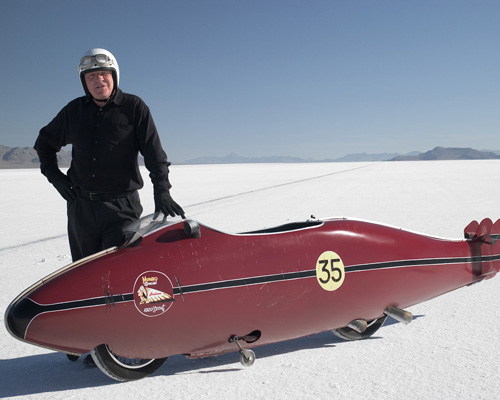
flick about Burt Munro’s efforts to make it to Bonneville from
New Zealand and
test his high performance skills on the salt flats. The movie hit
home in so many respects. It’s a film about a middle-aged man
who builds fast motorcycles in his garage. What would
strike a cord more resoundingly to this 40-year biker, whose
building
two motorcycles to take to Bonneville, and was on the team that
broke the World Land Speed Record in 1996.
It also hit home ‘cause Burt liked to do it himself, in his
funky, wood garage, and he had a good time. We
enjoyed every struggle, mechanical problem, shipping dilemma
and Burt’s never-say-die drive.
Is that the
Bikers Code (Code of the West), or what?
The movie was cool, but this PR guy, Tom Kidd,
contacted
us again and asked if we would like to meet the music
composer, J. Peter Robinson. At first I thought, he must be a
rider and enjoys Bikernet. Then I conjured they’re (the
production
company) offering Anthony Hopkins to Jay Leno and Robinson to
Bikernet. I was trying to make a connection, but stumbling. Then
it hit me. We’re not producing a music web site. What the fuck
can we write about? “Mr. Kidd,” I said over the phone, “does
Robinson ride?”
“Let me check,” Kidd said. All PR guys are required to
check.
A day later and two committee meetings, and I
received
a call, “Nope,” Kidd said. “He never rode. Folks wouldn’t let him.”
I cringed. No self-respecting man let’s rules
get in the way of riding motorcycles. There’s that Code of the
West again. I broke a pencil, threw it in the trash, shut
off my computer and headed to the shop. I needed to weld
something.
Kidd sent us J. Robinson’s impressive bio,
containing hundreds of movie and television credits including
the music for Wayne’s World and Jackie Chan’s First Strike. He
performed with Eric Clapton, Melissa Etheridge and Al Jarreau to
name a few. He’s written for John Schlesinger at Orion pictures,
Wes Craven at Paramount and Dean Semler at 20th Century Fox.
I don’t know shit about the music business so I called Black
Market John in the Bikernet Music Studios out front and said,
“What’s it mean?”
He didn’t answer. He was stoned. I went back to
welding. I burnt my thumb and came up with a notion—the bike.
Bikernet had to have the bike. I called Kid. “How about
something on the bike. I don’t want to up-stage the music, but
we’re a bike site.”
“I’ll check,” Kidd said and hung up.
Another 24 hours passed and an e-mail blipped onto
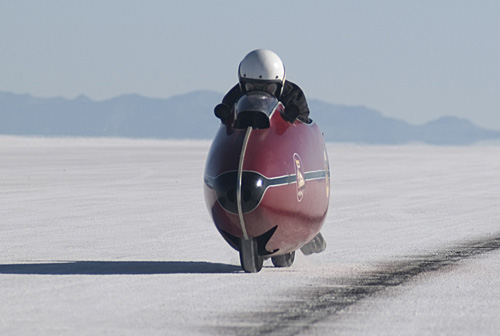
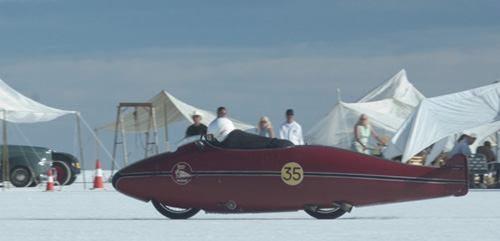
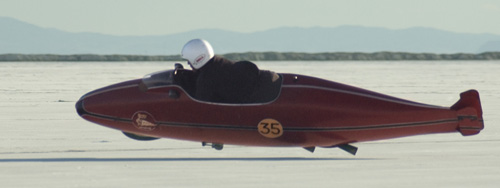
my screen. It glistened with a story about Burt’s racing history,
shots of Burt Munro, the bike and even the new owners. In less
than two hours the feature was published on Bikernet, in
Bandit’s Cantina, since it was a famous historic piece.
A couple of days later I was talking to Dave Perewitz
and it
dawned on me. I could look at J. Peter Robinson's musical
adaptation for the Worlds Fastest Indian similar to a
builder commissioned to build the music for this tribute to
speed. I called Black Market John again, since I don’t know shit
about composing music for a toothpaste commercial, let alone
an entire movie. He said something about rifts and I assumed
the gang was having an argument in the studio. I hung up.
I had a plan so we headed into Hollywood to the old
Thunder Roadhouse, which is now the Saddle Ranch country-
music
restaurant and nightclub. It rocks, every night. And the girls,
goddamnit!
The Kidd and J. Peter Robinson were eating nachos and
waiting as we rolled up. I’m a straightforward kinda guy so I
spilled my guts about my lack of musical acumen and
introduced them to our Black Market dealer. J. Peter confessed
that his folks wouldn’t even allow him to ride a bicycle. “That
didn’t stop me from sneaking out and finding a ride,” Robinson
said. He grew up in the south of England where there were no
sidewalks or paved streets. But in 1962 he straddled a Vincent
Black Shadow on the sly, gripped the bars in the town of
Brighton,
and dropped it at the first stoplight.
“I broke my leg under
that
monster,” J. Peter said and so ended his motorcycling career.
“I’m still a petrol head.” He enjoys speed and sports cars and
drives a
BMW M-5, 500 hp speedster, “I wish cars had the handling and
performance of motorcycles.”
My mind was spinning as I opened the soiled Saddle Ranch
menu
and tried to scan its contents. How was I going to describe to
our readers the building of a movie score and relate it to a bike
build? I just kept asking sordid questions and the process
began to
take shape. As it turns out the master builder behind most
movies is the director, in this case, Roger Donaldson.
As in building a custom motorcycle, the plan for a movie
comes from the Director. “It’s his vision from the beginning to
the end.” I was beginning to get the picture. J. Peter was the
painter behind the custom bike build. “It was a matter of
capturing Burt’s strange, quirky, likeable character,”
J. Peter said. Roger flew J. Peter to New Zealand to watch one
of the initial film cuts. “Piano seemed to be the thing,” Robinson
said of the general character of the movie. His formal classical
training in music revolved around the piano at the Royal
Academy of Music in London. Peter’s paintbrush (or airbrush)
was the collective keys on his piano.
I asked if he studied music from Burt’s salt flat era in the
late '40s. “It’s not
a period piece,” Peter said, “Film music should be timeless.” I
was beginning to witness how the man thought about the tunes
designed to follow Burt’s pursuits. “Even the funniest films have
drama,” he said. Burt’s character dictated lightness to the music
while following the slight drama of a straight documentary. Burt
was a
lighthearted guy who had tremendous drive for speed. His
struggles for goals and performance demanded moving feeling
without sentimentality. “I hate sentimental music,” Peter said.
“The director's love for the machines and his passion for going
fast
governed much of his direction. Roger produced a documentary
about Burt Munro in 1971."
J. Peter returned from New Zealand and organized his Piano
ramblings, like a painter may have organized his sketches for
the ultimate paint job. Then he gathered friends in the music
business, as if collecting the sheet metal for the job. He writes
and directs the music for two or three films a year in addition to
scores for television movies and series. I was sure he had access
to talented teams, like a painter has body men, bondo
specialists, airbrush artists and pinstripers.
With all the elements in hand, guided by the director’s
mental picture, Peter slept on the concept. Like any artist he
ponders his musical sketches. “With the piano as voice we added
marimba, guitars and orchestration,” Peter said. “Only ½ hour of
the movie lacks music.” He explained that generally 45 minutes
sans music, in a two hour movie is too much. That smacked of
the paintwork on a bike. Most of the time it contains sheet metal
and frame, but some builders stretch it to the wheel rims, oil
tank and headlight. At a point it becomes too much. “The music
must enhance each scene, without getting in the way.”
”It’s all about manipulating emotions,” Peter said, “It’s
critical to determine when to start and stop the music right
down to an individual film frame.” In Burt’s movie the Indian
took center stage several times as it whistled down the flats or
split the kid’s eardrums in the garage. Then occasionally the
music
replaced the Indian thunder for scene effect.
”There’s a rule in film making that if you see it you must
hear it,” Peter said. “That’s nonsense, but it’s often tough to
sway a director from the code.”
The next step included determining the size of orchestra to
use, sorta like the number of colors in a paint job or the depth
of each hue. Peter chose between a 45 and a 60-piece orchestra
depending on the music style, and of course the budget. “We
fight budgets, especially with heavy action movies,” Peter said.
“Cut one
special effect and let the music flourish.”
The next stage included mixing and editing as if a painter
stirring the paint formula and hitting the spray booth. Editing is
the
final sanding and polishing to draw out that world-class finish.
“The music is the raw material for a film’s background,” Peter
said. “Roger was very specific. It was a story of undoubtedly
spirit and about filling a dream. He had a tear in his eye when he
watched the final cut for the first time.”
Like a custom bike show display can add extra touches to
the final product, the DVD of this movie will contain the 1971
Roger Donaldson documentary about Burt, The God of
Speed. Roger was a Burt Munro fan and wrote the
World’s Fastest script. Peter was apart of his team and
worked with Roger on two
other movies, Cocktail and Cadillac Man.
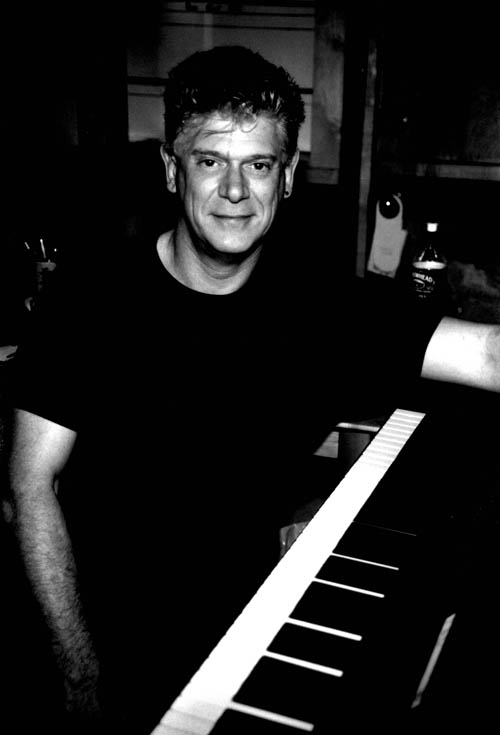 J. Peter Robinson. The man behind the music.
We left the Saddle Ranch Nightclub with a thorough
understanding of the music behind a film and it worked,
equating
it to a top-notch paint job on a master builder’s bike. It must
enhance without demanding attention. It must thrive to follow
the lines and the master’s direction. Or was it the three-whiskey
lunch that
made the connection work?
Like bike painters who are men of honor, promise what they
deliver and go the extra mile for the builder, J. Peter obviously is
a craftsman who makes good on his word. It’s apparent by his
bio,
he’s a talent who takes direction, shows up on time and makes
the project work within budgets and guidelines. A man of honor
who contains this level of talent—a rarity in any circle.
 No she’s not the Saddle Ranch girl, but she’s a
start.
 Sponsored By Bikernet.com.
 Bikernet
 Bikernet Baggers
 Women Riders Now