
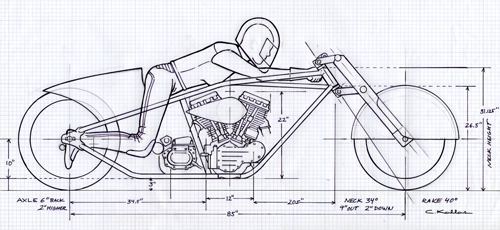
In this chapter we’re taking all the plans, boiling them in oil
and spinning them into action—no bullshit. The frame is
underway, as you will witness. The wheels are in hand. The
transmission was delivered and the Avon Tyres were shipped
today.
The notions and input keep flying my way via e-mail and
phone calls, but let’s jump right into the middle of the action,
beginning with Rick Krost, who is building our Assalt Weapan
frame, at U.S. Choppers:

This is Leo’s classic neck with locking old school cups
and internal fork stops.
Seriously, I need to get engine dimensions first. Also
would like to know centerline numbers from engine shaft to
tranny shaft if you have a primary and clutch pack picked out. If
it's all production stuff--that’s fine, but realize that some guys
produce their primary with the wrong measurements making
the belt too tight, which in turn makes for a shitty clutch and
near impossible starts......so just because they have a big name
still doesn't mean their products work!!
If we have a primary in hand, I can use it when building the
frame for real numbers, so we don't experience binding in the
drive-
train (we use BDL and have never had a problem). Remember, if
Berry, Accurate Engineering, does his job perfectly, as I assume
he will, then we can lose all of his talent through the primary/
clutch set-up. If you have those numbers, I can start getting
my drawings together and start frame building.
Also front and rear tires will vary from 23.5 to 28 inches
depending on the side-wall heights and rim sizes - 23.5 for 16-
inch rims to 28-inch for 21-inch rims.... plus or minus the side-
wall and tread differences..... this is a 5-inch disparity that we
must make provisions for! I believe Chris Kallas (official 5-Ball
racing illustrator) has both wheels at 26 inches, if I am reading
the drawing correctly. This would most likely mean a 18-inch
rim in back and front with 4 tall side-walls and tread. If we are
at 26 inches then the axle center would be 13 inches off of the
ground as Chris illustrates.
To make our measurements linear, then of course, the same
would apply for the front tire measurements to make the frame
level to the ground as the drawing illustrates......(so I believe we
should have our tires and wheels first, in order to make
measurements for the frame and front end). This would assure
we don't run into any problems with regards to having 3 inches
of ground clearance from front to rear and we can make
accurate assumptions for front end length and trail calculations.
Get this, if you make a perfect structure and set it on an
imperfect surface, all of those measurements were for not. Thus
like a tailor fitting a suit, we must have a starting point.
My
thought is that the starting point should be the axle heights and
if we are to nail down those, then we need an accurate
measurement of the entire front and rear wheel diameters with
the correct Z rated Avon tires mounted and aired up to real air
pressures........
Just a thought, but keep in mind, I'm just a simpleton with a
wheel cage that moves about 3 rpms...... so take it for what it's
worth.
Also we need to dial in that trail measurement better than
"zero" as Chris stated earlier. That would really make me
nervous!! I know Leo is our man for that, as he has a lot of
potential with the Girder style set-up and it's infinite
adjustability. However, I feel like he can do his job better and
easier if he has a neck height from me and some "real" axle
references as stated before. He can then figure his leg length,
calculate for trail/rake and any "sag" on the front end.
Getting really excited about this project- lets get these
numbers nailed down and get rocking!
--Rick
U.S. Choppers
2039 S. Lyon St
Santa Ana, CA 92705
714-546-4699
Appointments Only Please
http://www.uschopper.com

After we received Rick’s e-mail we informed him that we
generally use only BDL primary drives and never had a problem
with their configurations for Softails or FXRS. We researched our
wheel diameters for Chris Kallas and Rick through Avon Tyres.
Our wheels with tires mounted should be 24.6 front and 25.8 in
the rear.
We now have the All American Wheels cut by Renegade in
hand and the Tires
are on their way to us. I will have them mounted and deliverd to
U.S. Choppers A.S.A.P.

NICK ROBERTS, 5-BALL SPONSOR SPEAKS UP FOR NICK’S
PERFORMANCE AND AMSOIL OILS--
Great update...I like where you're going with this and I only
have a couple of thoughts that I'd like to toss in.
First a question...why is a headlight included in the concept
drawings? Is there a requirement that you have a headlight? I
would think this area would respond to a more aerodynamic
form such as a cover over the steering head and trees and may
eliminate a lot of potential turbulence and drag. When I look at
the concept drawings my other thought regarding aerodynamics
is that the exposed engine is going to cause all sorts of
turbulence.
We must run an open front end and can drop the headlight
in our class, but we need to push the air out around the front of
the bike. Unfortunately V-Rod headlights don’t cut it—only
allowed on V-Rods. Regarding the open engine we hope to use
the pipes and air cleaner to guide the air. Plus, we need some air
through the engine for cooling on the hot salt.
Secondly....Thinking back to the Trials it seems like almost
all the bikes with fairings, (streamlining), covered their engines. I
appreciate the aesthetics of the exposed Panhead engine but I
wonder if it wouldn't make more sense to design a fairing
around the engine to channel the air needed for cooling while
smoothing the airflow around the bike and Valerie. Just thought
I'd throw that out for you to consider while you are still in the
design phase of the project.
We are running in the open bike class. No fairing
allowed.
Several years ago I was in Jerry Bickel's shop where he builds
Pro-Stock drag cars. Jerry had an interesting analogy for
thinking about the effects of airflow and ways to cheat the wind.
He thinks of air as a fluid that he has to manage in order to slice
his way through it on the way down the track. He stressed that
the biggest problem he faced was the air clinging to the car and
hence creating more drag.
There’s an interesting anomaly involved in cutting air.
This is our golf ball theory. It was discovered years ago that
smooth golf balls wouldn’t travel as far as the dinged brothers. I
was told that air gathers on a surface and creates a Tephlon like
coating which allows additional air to glide over it effortlessly.
Hence a coarse finish is more beneficial that a slick polished
one.
Jerry came up with some ingenious ways to add velocity
generators to the rear quarter panel in order to break the air's
hold on the body. In the case of his cars the rule book didn't
allow anything like velocity generators; so in true racer fashion
he came up with the idea to modify the stickers on the quarter
panel which created the desired turbulence and broke the air's
drag; allowing his car to gain few extra seconds advantage. The
tech guys searched his car at several events before they
discovered his innovation and banned it. Any mention of velocity
generators in the rule book? My point here is that there are a
number of ways to cheat the wind, and lessen the attendant
frictional drag, that don't require major modification to the
overall design.
We’ll look into VGs.
N.R.H.S , nrhsperformance.com, in Boulder, Colorado went
217 mph on a Buell at the Speed Trials and they may have some
insights they are willing to share. Their bike has quite a bit of
streamlining as well as the fact that they are experienced with
Land Speed Racing having been involved for several years. You
might want to give Daniel Dunn at N.R.H.S. a call and get his
thoughts about the effects of aerodynamics on the bike at 200+
mph. His number is 303-833-4500 and email is
[email protected].
Thanks Nick, I’ll do that.

 A new take on the Assalt Weapan by Dick Allen.
THE NITROUS CONSIDERATION-- www.coldfusionnitrous.com Dobek
at Techlusions works with these guys. Very good prices!!!!! The
other one I also look at also is www.nitrousexpress.com Cold Fusion
has some real cool nozzle adapters for EFI injectors.
Don't know if you are goin this way for power (200 MPH
Club). If you are, is to be "carbinated" or "Infected"??? Multiple
stages might be a real good idea. Forget about "Dry Nitrous."
Daytona Twin Tec has good EFI systems. V-Thunder has a
simple module for a carbinated system with Nitrous.
One thing I saw on the bike was that front shot with Val on
it. Adios those handle bars!! Get something goin low
and close to the fork tubes. A girder made from aircraft tubing
would be real bitchin.
Air-Tech makes good aero body work stuff.
Have you thought about changing your exhaust at all???
Also looking at the pictures of the engine do your oil returns in
the left case side dump onto the flywheels???
--Pablo
We are running with Pegasus EFI from BDL and the pipes are
scheduled to be built by Berry Wardlaw of Accurate engineering
and Larry Curik from Lone Star Choppers.--Bandit

 Grab the whole rewritten story in this fantastic book. Just click on the image.


LET’S STEP BACK IN TIME FOR A BONNEVILLE LEGEND--
The following photos and copy about the 1949 Vincent Black
Lightning – Supercharged,
are from the Solvang Museum site (pashnit.com)
This is one of only 30 Black Lightnings ever made and was
the first one in the USA. This bike held the 1-mile world speed
record (unsupercharged) in 1953 and then held the American
record of 182 mph supercharged. This is probably the meanest
pre-1950 bike you will ever see. This bike is located in the
Solvang, California Auto Museum.

On a cool Monday morning on Sept. 13, 1948, Rollie Free
lifted from Harley- Davidson the US national motorcycle speed
record by riding the first Vincent HRD Black Lightning racing
motorcycle to a speed of 150.313 m.p.h. When Rollie's leathers
tore from early runs at 147 mph, he discarded them and made a
final, heroic attempt without jacket, pants, gloves, boots or
helmet.
Aboard the motorcycle owned by the California sportsman,
John Edgar, this final run resulted in the most famous
photograph in motorcycling, the "bathing suit bike" shot taken
from a speeding car on the Bonneville Salt Flats in Utah. Rollie
lay flat out on the motorcycle wearing only a speedo bathing
suit, shower cap and a pair of borrowed sneakers.
 One of the more famous pictures in motorcycle history.

The AMA certified Free's record. Special features included
the first-ever Vincent use of a rear shock absorber, the first Mk
II racing cams and horizontally mounted racing carbs.

BONNEBELLE SIDEBAR--This bike is also coming
together for Bonneville 2007. It’s a 45 flathead with a K-model
top end being rebuilt and hopped-up by Departure Bike Works
in Richmond, Virginia.

We are waiting on a set of original 45 flathead pistons,
which Ross Pistons will turn into higher compression K-Model
pistons with the Ross touch. They should arrive this week.


HEADGEAR RECOMMENDATIONS FROM A BIKERNET
READER--
I've written the few of you that I thought might appreciate
quality racing gear. Tee Hee.

I'm not sure if it's SNELL approved, but I think I found the
perfect helmet for use at Bonneville.
Can you imagine showing up at tech. inspection....
Let's see, Boots, Gloves, Leathers,....Whoa..what the F*ck is That!
--Drew Gatewood

Meanwhile back at the U.S. Choppers playground the frame
began to take shape. “The kids were cranky and of course, as all
youngsters are, lacking many things for us to finish,” Rick said.
“No 5/8-inch tap in the whole shop! This stopped the rear end
fixture we needed to make to produce a frame this length. No
front motor mounts etc..... next Saturday.
 Setting neck angle to 34 degrees- sounds pretty cold- but
not freezing yet.......the shop came in at 42 degrees F.
 Hardcore machinist getting ready to machine fixtures for
this super long frame.
 My boy Marcio, who never smiles, was caught off-guard in
this rare moment
from one of my buddies at Ace's. They promised me it would be
all fun and games, however they pissed and moaned all day long
and then drove off in their luxury cars. Gosh Marcio, your
making it look like this kind of work is actually fun. That’s the
spirit !! Go Bonny!
 Starting to look like the picture,
although, the top backbone needs two bends to make the fit
proper. You can see both bends in this pic.
Aces handled U.S. Choppers first run of Street Platform
frames and we have become friends since. Both Marcio and
Luke are good guys who deliver what they promise. “Their sense
of humor is a bit strange, though, and I really feel they should
get out more,” said Rick. “Four of us worked on a Saturday to
see this Bonneville bike come to fruition. Rick, Marcio, Luke,
and Lunger (our machinist friend who is suffering from some
serious flu type symptoms). He had to operate the machinery
without medicine for safety sake.” The four musketeers will join
again for their next epic battle (next Saturday)- stay tuned!

CONCEPTS FOR SPEED FROM JOEL
PEVEY--
No offense, but Chris Kallas' last drawing was a bit scary --
it is his best 'to-scale' drawing yet, but 2 feet over length? - see
drop tube angle - motor can be positioned much farther fwd,
with legs more towards the vertical, but we'll need to review
rider position and using ballast in more detail later.
Again
no offense - his latest is already an improvement on last year
and will be workable if that is what you have decided on already.
It’s not 2 feet over. Actually it will be stretched 6 to the rear
and 8 to the front.
Rick Krost had mentioned possibility of going with a dual
downtube, a two-leg frame. Might want to take him up on that.
Dual top tube also, at least from center post back?? Will explain
why later. Can also get sketches to you - too bad I can't draw for
shit, but I'll do the best I can.
 Joel sent this modified photo of Val to point out
the handlebar variation for less wind drag.
GET WITH BERRY ON FINAL DIMENSIONS OF MOTOR. I know
you gave Rick the dimensions of last year's motor, but didn't
Berry say this "ONE OFF" will be very different? The engine
dimensions determine EVERYTHING else. Engine 1st, VT20
second.
That was handled by Berry directly with Rick, Admiral.
WHEN ARE YOU FLYING VT20 (Valerie Thompson, our Go-
Daddy Rider) out for fitting to frame? That is our first real HARD
TARGET DATE.
- Any other dates or schedule known? Test dates at El Mirage,
for example? Just asking.
Agree 100% on "...we will build the bike to fit
her like a glove."
However, would YOU like to tech the bike and take it for a
couple runs the day before VT20 shows up? When it comes to
feedback on handling, balance, controls, etc. There is nothing
like first hand experience. PLUS, it would make for great Bikernet
content!!! What the hell - get Bates or Vanson to donate a set of
leathers with Bikernet and 5-Ball Racing graphics all over them,
and go for it!!

Our plan is to have Valerie fly out in about three weeks for
our initial fitment and moulding party. We’re going to cover her
in foam and push her around the block. Hang on for that.--
Bandit

UPDATED FRAME DIMENSIONS FROM CHRIS KALLAS--
Here's a crack at modifying the fork angle. I cut-n-pasted the
wheel back to
where you'd have about 3.75 inches of trail. Guessing the fork
angle at about 32 degrees.
Wheel base comes to approx. 81 inches instead of 85.
Depending where your at with
Rick and Leo's progress this could be a moot point, plus this is
based on my
preliminary frame dimensions. May still be a glimpse of what it
might look like.
--C. Kallas

LEO’S RESPONSE TO THE NEW DRAWING--
This will work into the plan perfectly.
What we have been heading toward, will now come to life by
adjusting my relations of upper and lower control arm length to
each other thru the eccentric in the control arms then moving
the shock so the control arms run parallel to the earth I will
build more trail and get wheel closer to the power-plant of the
bike to decrease the size of the perpendicular thru-air pockets
effectively making it more like a streamliner as we have been
discussing . Good work. I'm still working on the note from my
mom.
--Leo DiOrio
 Bikernet
 Bikernet Baggers
 Women Riders Now