
This will switch, change and fluctuate through out the
process, but the notion is simple—Build The World’s Fastest
Panhead. Of course there’s no goddamn Panhead class, but what
the hell. We’ve never followed any rules in the past, why start
now. I’ll ramble about racing on the salt, some of the rules and
some of the notions behind our concept. See if you can keep up.
I joked at the Bubs International Speed Trials on Bonneville
Salt flats for 2006 that I tried to learn something daily. At
Bonneville, surrounded by devoted racers, and Salt snorting
maniacs I learned speed info by the minute. Some of the key
elements we absorbed were aerodynamics and gearing. Our
code this year will be to build a bike fitting our rider, Valerie
Thompson, comfortably and like a glove, to be a wing slicing
through the air. It needs to move comfortably through the
atmosphere, free to make the speed of 200 mph and yet handle
like a dream. No streamlining. We’re shooting for an open bike,
but the rules and regs are delicate. There’s a trick to staying out
of the partially streamlined class, yet making the bike as
aerodynamic as possible.
 Here’s how Val saw the air she split at 145 mph in
2006. We need to hide her from the wind this year.
I learned from old salts, like Mil Blair, that my thinking was
somewhat accurate. If we follow the wing notion, the front end
will handle and remain stable while the tail will allow the wind to
close around the chassis without creating drag on the power
train. This is critical to world land speed record success
according to the masters of the salt, like Wink Eller, who now
works for BDL between races.

Speaking of Drive Trains. We ran an Accurate Engineering,
120-inch Panhead motor last year for shits and grins. But I’m
sticking with this power plant for several reasons. First, it was
built by one fine engine builder and a brother, Berry Wardlaw,
the boss of Accurate, who is passionate about this industry,
every goddamn thing he does and speed. He’s my partner in this
endeavor and a brother I can reach out to for anything, at any
time. He bleeds 60 weight and snorts nitrous. Let me finish
about the engine, then I’ll shift to nitrous systems. Three
notions in the engine reasoning department. First, is the
Panhead heritage. Panheads were built from the year I was born,
1948 up to 1965, the year before I graduated from High School.
They’re my favorite H-D engine configuration, and when it
comes to Bonneville racing they add a sense of class. Finally,
who the hell would bring a 50-year-old technology to
Bonneville, to set a record except the Bikernet 5-Ball Racing
nuts.
One of the myriad of things I noticed on the salt was the
power notion. Lotsa guys feel it’s all about power and engine
displacement, yet a 50 cc streamliner is capable of 130mph and
a 440 cc open-bike Buell Blast also cut through the air at 135
mph. Also, when a guy looks at me like I’m nuts, to even
mention 200 mph, I envision a stock Hyabusa, capable of 200
mph on a freeway. Keep those mysteries in mind as we stumble
through this effort.
The Tranny will be a direct drive performance Baker 5 or 6
speed (we haven’t decided), linked to the engine with a BDL belt
and clutch system. We will run chain to the rear to allow easy
rear wheel sprocket alterations. Mil Blair recommended Hyabusa
wheels for the 200 mph reliability and design. I will study those
wheels but hope to run a solid U.S.A built wheel in the rear and
nearly solid wheel in the front (by the rules 30 percent of the
front wheel area must be open). I want to prevent any loss of
power or additional drag from the paddle-wheel effect of wheel
spokes or billet shapes.
 Here’s Roger’s bike with Leo DeOrio’s front end.
We are working with Leo De Orio on a shapely girder front
end to enhance the aerodynamics of the front end and handling.
One of Leo’s front ends led Roger Goldammer’s build-off
Bonneville effort last year, and it was sleek and killer looking.
I’m hoping to run a 19 front and 18 rear, but keep both wheels
narrow, especially the rear wheel for aerodynamic purposes.
There’s a slippage consideration. At speeds some bikes loose
grip because the rear end is too light, the tire too hard, or not
enough patch on the ground. We won't worry much about the
weight issue. Having weight at Bonneville is a plus. Many bikes
are small and light. They want to lose traction and fly away at
speeds on the salt. We will run the oil bag under the
transmission and perhaps additional low center of gravity weight
to hold her down at speeds.
 The 5-Ball fighter poised for battle.
Our plan is to build the roller first, then fly Valerie out from
Phoenix to the Wilmington, CA ghetto and the Bikernet
Headquarters. We hope to form a mold of her lovely-self while
straddling the bare frame. We want her to become apart of the
bike, and build it in such a way that it is absolutely comfortable
and manageable to ride. The more comfortable and vibration
free, the easier it is to handle and maintain vision at 200 mph.
Besides we want our pilot to be as comfortable and confident as
possible. It’s official now. She took 6th place in Destroyer points
standings for 2006 and was 11th in 87 Destroyer riders
nationwide.

One of our crazed goals is to make this an open bike.
There’s several classes: Production, modified, special
construction, modified partial streamlining, special construction
partial streamlining, sidecar, sidecar streamliner and
streamliner.
There’s also a number of engine classes:
Production
Production Push Rod
Production Supercharged
Production Vintage
Modified Engine: Gasoline
Push Rod Engine: Gasoline
Unlimited Engine: Gasoline
Supercharged Engine: Gasoline
Supercharged Pushrod Engine: Gasoline
Supercharged Vintage Engine: Gasoline
Then the list starts all over again with Fuel at the end. Wink
Eller is the master of classes. He’s a racing maniac and when he
started chasing World Land Speed Records he studied the
Southern California Timing Association Record and Rule Book
and sought achievable records. He searched the record books
for untouched records and built bikes specifically for low or
never-set records. There’s another category I left out, the engine
displacement button. Those categories run from 50 ccs all the
way to 3000.
50
100
125
350
500
650
750
1000
1350
1650
2000
3000
Get this. There are three sanctioning bodies. The SCTA
mentioned above authorizes racing at the El Mirage lake beds in
California and two events in Bonneville: Speed Week and the
World Finals. Bub’s event is only sanctioned by the AMA and FIM,
the European sanctioning body. While standing on the Salt and
trying to figure out what category the Bikernet Salt Shaker was in
last year, I discovered that my 120-inch Panhead fell in the
special Construction, Pushrod, fuel or gas, 2000 cc category.
There was no record for my bike. Unbelievable. I consider myself
lucky, but that roll-of-the-dice took the cake.
That’s just a taste of our notions. Hang on as we plan,
change the sketch and move forward. Berry’s studying nitrous
systems. Leo is working on handling, rake and trail. Chris Kallas,
the artist behind our sketch, is working with Valerie on more
info to refine our drawings. I’m working with Rick Krost of US
Choppers on our frame. Hang on.
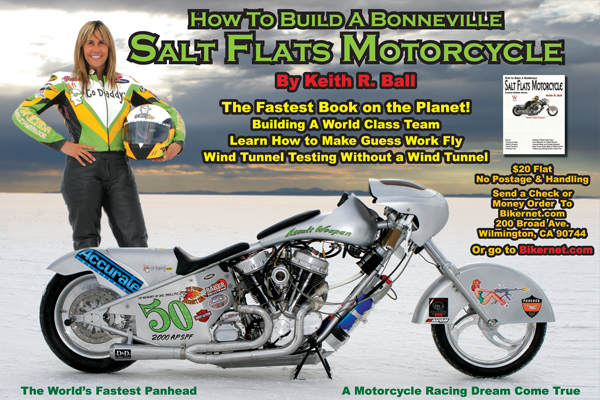 Grab the whole rewritten story in this fantastic book. Just click on the image.
 Bikernet
 Bikernet Baggers
 Women Riders Now