
Hang on, as we ramble into this report after feeling stuck on
a Pacific island reef. Our frame team fell apart, and I was forced
to pick up the phone, calling my longtime friend, Bob Clark and
Ron Paugh from Paughco, around the middle of February.
Remember, we wanted to have the frame, wheels and front end
completed before the end of 2006. We’re burnin’ daylight
quick. Within 24 hours the Paughco frame was a go. We shipped
the most
recent Chris Kallas illustrations to Carson City, Nevada so the
Paughco team had a guide. That made Chris Kallas nervous.
“Wait,” he said. “I’m not a frame designer.” We’ll get into that
later, but his concerns were noteworthy and we investigated.
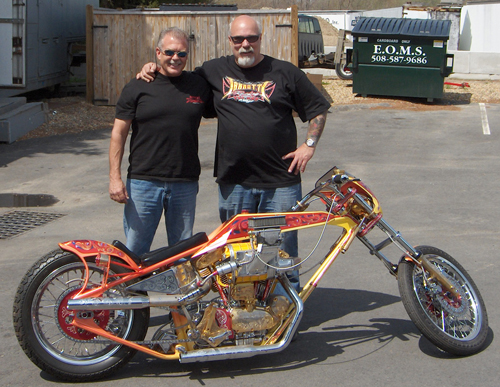 Bob Clark and Dave Perewitz.
While we bit out nails and waited for word from the Paughco
Headquarters, Bikernet readers continued to poor in their speed
notes.
Bandit, I see you got your wheels for the Pan. You might
want to consider a set
of ceramic wheel bearings. Check with Dave at World Wide
Bearings, 1-800-575-
3220. They are used in pro stock drag bikes and many LSR
bikes. I have heard of
four horsepower gains at the rear wheel because of less parasitic
loss through the
drivetrain. I installed a set on my bike and didn't do any dyno
testing but the
bike is much easier to roll around. Might be worth a look. Good
luck in
September.
We’ve also been told not to run O-Ring chains Eric and his
dad, Bob, from Bennett’s Performance on Signal Hill, in Long
Beach, California threw-out the following speedy notions (562)
498-1819.
“We
run 30 weight oil to minimize drag,” Don said. “We were also
told not to run O-ring chains for the same reason and even run
520 chain, to reduce the weight turned by the engine in the
drivetrain.”
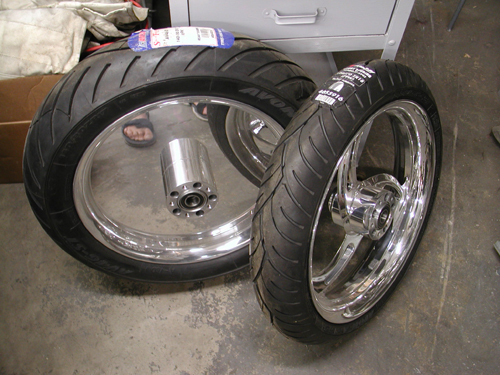
We also told the Bennetts about our new All American
wheels
machined by Renegade, and they asked about our tires. “Are you
planning on shaving the tires?” Eric asked. Many tires are shaved
to alter or enhance their speed category. If a tire is shaved, it
moves into the next higher speed category.
”We have a local performance expert who claims an
additional 15 mph on shaved wheels,” Bob said and I was sold.
“He shaves and balances the wheels.”
We will look into shaving the wheels as we also consider our
ground clearance. “Nascars run virtually next to the ground,” Eric
pointed out.” We hope to fly out to the University of Austin to
work with Dave Rash, the president of D&D on their Bonneville
V-Bike. I want to understand how ground clearance may differ
between Nascar handling and running a bike on the salt. I
recently watched a German speed trial with a 253 mph Bogati
Sportscar. At speeds, the car automatically lowers itself to
enhance its ground clearance and speed. More to come on that.
For now the American/Renegade wheels were fitted and
balanced with Azaro Avon W-rated (appropriate to our class)
tires mounted by Settle's Motorcycle
Shop. Larry Settle guaranteed that they are round...


Another reader spoke up:
It sounds like you are planning to run the Pan in altered and run
without a fairing, but you might consider a fairing and bodywork
to run APS too. A few years ago Scott Guthrie ran several back
to back runs on a 200 mph Suzuki Hayabusa with and without
the faring and body work at the Maxton mile. They discovered
the bodywork was worth 14 mph at Maxton, so it should be
worth even more at Bonneville.
Airtech built a sharp body
for
Wink Eller's 200 mph Bonneville Harley. It's on the Airtech
website www.airtech-streamlining.com under the Harley tab.
Might be worth a look.
--Rick
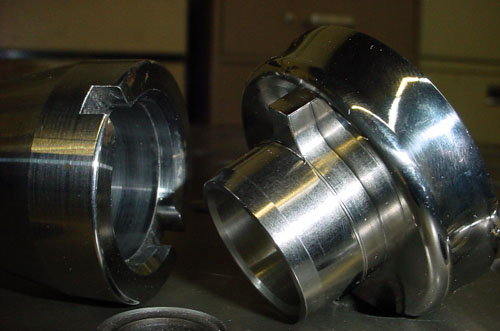
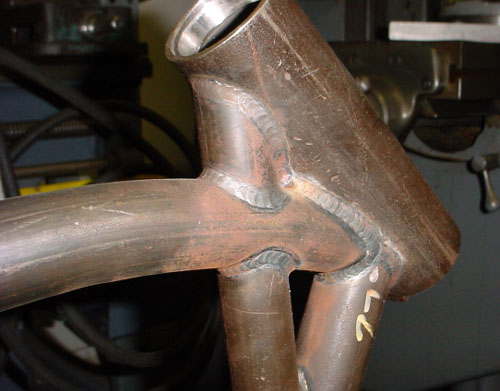
 We ended up with several neck options. This one
came from the master of suspension, Wil Phillips.
Neck Correction--
We received several necks during our initial frame design
effort. Leo DiOrio sent the following regarding his offering to
make sure
Joey Perse received the proper credit:
If you do something, article wise about the neck here’s the
scoop. Joey Perse, of Perse Performance, made it, and I found it
in his special projects room.
I work with Joey on special projects and I am able to move
around the facility without an escort (the place is a missile plant
for motorcycles).
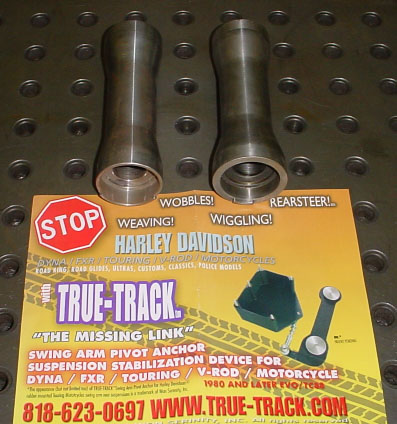
The idea behind the neck included using bearing cups to
take advantage of the industry standard in fork-stops without
any extra welding or pinning of the cups to the neck, which in
turn means that the neck is still serviceable and reliable without
special tools or increased labor, and it opens the end-user up to
many triple-tree options without bump style frame stops.
When I told him I needed this for your project since frame
maker, U.S. choppers is working on the frame and I'm in
Colorado
working on the front end, he said for me to take it and let him
know what I think.
Don’t state that I built this. It is very important to me that
accuracy is applied when talking about innovation.
--Leo DiOrio


Once I received the Assalt Weapan-saving go-ahead from
Paughco, I was contacted
by Bob Clark, the former managing editor of HOT BIKE and Street
Choppers, way back in the ‘70s. He asked me what I needed and
I told him a custom frame for our Bonneville effort. He wrote,
“Triumph Bonneville?
”No goddamnit,
It's for our Bonneville racing Panhead called the Assalt
Weapan,” I returned in reserved tones. That started a flurry of
emails with Chris Kallas drawings.
“Tell him I'm running 1-inch axles and a 120-inch
Accurate Engineering Panhead engine and a Baker Softail 5-
speed transmission. Let me know if you need anything else?”
Fortunately the project was yanked outta Bob’s hands and
turned over to Jason
Paughco Inc, Frame and Springer Specialist.
”Let me know if you need any engine dimensions, etc?”
I asked. Nowadays ordering frames is a comprehensive chore,
like a Shovelhead won’t fit in an original rigid frame, or an Evo
won’t fit in a Shovel frame. Fortunately this 120-inch Accurate
Pan is 3/16 under an Evo height, but some performance engines
demand more clearance.
Jason knew what to ask. “Perfect, what about things like
tank or oil tank mounts and a rear brake
mount? And I'm also assuming you will be running a 5-speed
(Softail style transmission
cases)."
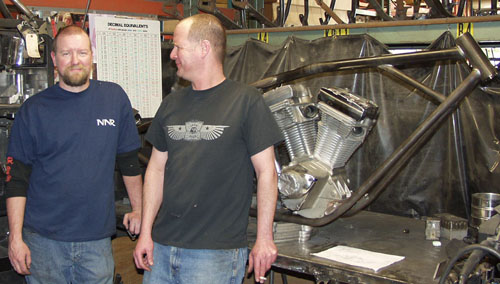 ”Almost long enough to be two frames,” Jason told me.
”The Gas tank will be completely custom,” I said, “so
we don't need any mounts. Standard oil tank mounts will be fine
(although I didn’t plan to use them for the oil tank). The rear
brake will be Softail type disc brakes, with a 1-inch axle. We are
running a Softail style 5-speed Baker transmission and a narrow
rear wheel (140/17), no offset.
”Okay that all sounds good exept the 1-inch axle,” Jason
told me. “Our ‘regular style’ axle plates
will only accept ¾-inch axles unless you open the plate holes
up.
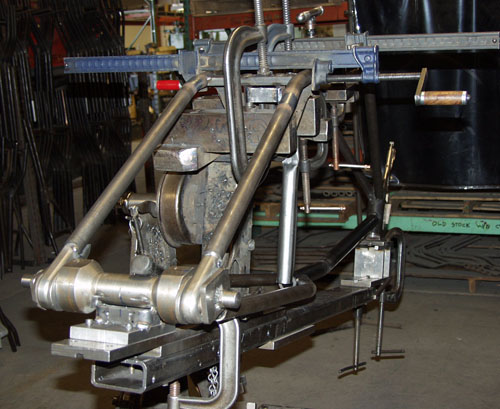
”We can offer you a 1-inch axle only if you want hidden axle
plates. I don't
figure you would want those because of the weight factor.”
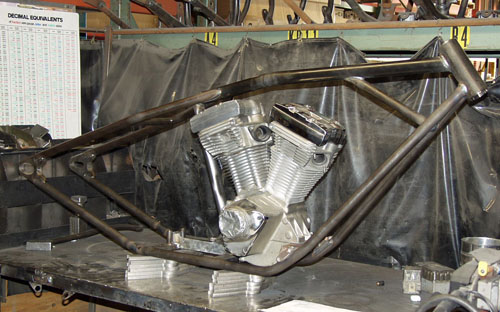
Actually weight is not a factor. We want weight especially at
the rear to gain traction on the salt. We may fill the bottom rails
with shot for more weight and I plan to build the oil bag under
the frame.
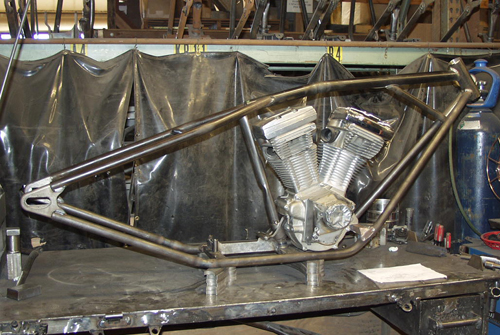
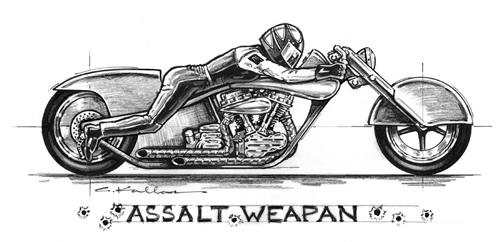
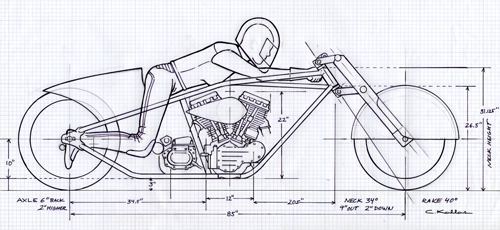
Chris Kallas, our esteemed illustrator, was concerned about
wheel travel on the girder and possibly the tire hitting the neck
area. I asked Leo DiOro, the girder designer, to double check
that aspect. I also reached out to Jason. “We can always make
the downtubes longer,” Jason said.
Let me know your thoughts,” I said to the god of speed. “
The front tire is 25 inches in diameter.”
Rightly so, Chris didn't want us to receive a frame then
be forced to modify it.
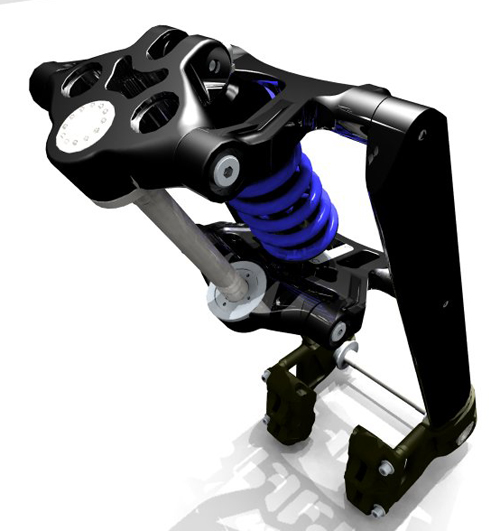
Here’s what Leo wrote to Jason: My name is Leo DiOrio, I
am writing you because, I am building the girder for the salt
flats Panhead belonging to that bastard, Bandit, the emperor of
5-Ball Racing. Don’t tell him I wrote you.
Chris Kallas would like to go over the numbers with me one
more time just to make sure.
I going to build a math model based on the numbers, we
are trying to achieve dimension wise, then when we see the real
thing.
A: when the bike is level how much ground clearance does it
have?
B: what is the neck height from the ground to the center of
the neck?
C: What is the distance over the bearings?
D: Are you going to use the neck I have provided, if so then
I can answer C?
E: What is the rake on the neck. I think we are trying to
achieve 34 degrees. Is that correct?
I have the tire Diameter. When I get this. I will build a
couple of stick models to show the 5-Ball Racing boss the
results,
and we can go from there. I think were fine but it's been awhile
and it’s best to make sure.
--Leo DiOrio
303 438 8991

Chris Kallas had additional concerns and wanted to factor
them into the drawings:
If you come up with a length for your fork and give me some
dimensions, I can rework the drawing to make it work. We had
the neck at 34 degrees. I'm also thinking we should raise the
frame to 4-inch ground clearance to be safe. Any thoughts on
that?
--Chris Kallas
 Chris Kallas art available in the
Black Market.
While the questions flew through Internet lines, the crew at
Paughco built the frame with 40 years of confidence. They had
no way of knowing the actual
ground clearance without the wheels, and they don’t work with
those parameters. They built smooth custom frames for four
decades
and have their distinct process nailed to the concrete. It would
be up to us to work out the rest.
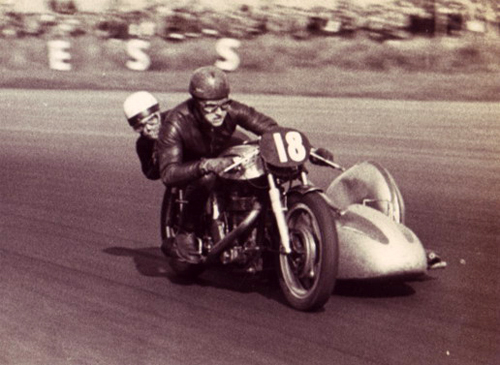 In addition to studying finish we planned to fly to the
University
of Texas with Dave Rash, the President of D&D exhaust to study
wind tunnel dynamics. I’m particularly interested in how low the
bike should be compared with NASCAR formulas. We’ll see.
I had a growing question, and I put it in Rick Krost’s lap.
He’s the
president of U.S. Choppers and informed me of the golfball
speed and distance theory. At one time golf balls were smooth
until someone tested the dimpled ball. It eclipsed the smoother
version. “If you have any time, could you research the golf ball
aerodynamics element,” I asked. Should we dimple our sheet
metal or just coat it with wrinkle paint? If you find any studies or
papers, we will implement the findings.”
We discovered that it was more than just finish to eliminate
drag. We also discovered that dimpled balls have less drag, but
the shape of a wing has even more drag reduction than dimpled
balls. A teardrop is the most aerodynamic shape of all. Ah ha.

Once I received the Assalt Weapan-saving go-ahead from
Paughco, I was contacted
by Bob Clark, the former managing editor of HOT BIKE and Street
Choppers, way back in the ‘70s. He asked me what I needed and
I told him a custom frame for our Bonneville effort. He wrote,
“Triumph Bonneville?
”No goddamnit,
It's for our Bonneville racing Panhead called the Assalt
Weapan,” I returned in reserved tones. That started a flurry of
emails with Chris Kallas drawings.
“Tell him I'm running 1-inch axles and a 120-inch
Accurate Engineering Panhead engine and a Baker Softail 5-
speed transmission. Let me know if you need anything else?”
Fortunately the project was yanked outta Bob’s hands and
turned over to Jason
Paughco Inc, Frame and Springer Specialist.
”Let me know if you need any engine dimensions, etc?”
I asked. Nowadays ordering frames is a comprehensive chore,
like a Shovelhead won’t fit in an original rigid frame, or an Evo
won’t fit in a Shovel frame. Fortunately this 120-inch Accurate
Pan is 3/16 under an Evo height, but some performance engines
demand more clearance.
Jason knew what to ask. “Perfect, what about things like
tank or oil tank mounts and a rear brake
mount? And I'm also assuming you will be running a 5-speed
(Softail style transmission
cases)."
”Almost long enough to be two frames,” Jason told me.
”The Gas tank will be completely custom,” I said, “so
we don't need any mounts. Standard oil tank mounts will be fine
(although I didn’t plan to use them for the oil tank). The rear
brake will be Softail type disc brakes, with a 1-inch axle. We are
running a Softail style 5-speed Baker transmission and a narrow
rear wheel (140/17), no offset.
”Okay that all sounds good exept the 1-inch axle,” Jason
told me. “Our ‘regular style’ axle plates
will only accept ¾-inch axles unless you open the plate holes
up.
”We can offer you a 1-inch axle only if you want hidden axle
plates. I don't
figure you would want those because of the weight factor.”
Actually weight is not a factor. We want weight especially at
the rear to gain traction on the salt. We may fill the bottom rails
with shot for more weight and I plan to build the oil bag under
the frame.
Chris Kallas, our esteemed illustrator, was concerned about
wheel travel on the girder and possibly the tire hitting the neck
area. I asked Leo DiOro, the girder designer, to double check
that aspect. I also reached out to Jason. “We can always make
the downtubes longer,” Jason said.
Let me know your thoughts,” I said to the god of speed. “
The front tire is 25 inches in diameter.”
Rightly so, Chris didn't want us to receive a frame then
be forced to modify it.
Here’s what Leo wrote to Jason: My name is Leo DiOrio, I
am writing you because, I am building the girder for the salt
flats Panhead belonging to that bastard, Bandit, the emperor of
5-Ball Racing. Don’t tell him I wrote you.
Chris Kallas would like to go over the numbers with me one
more time just to make sure.
I going to build a math model based on the numbers, we
are trying to achieve dimension wise, then when we see the real
thing.
A: when the bike is level how much ground clearance does it
have?
B: what is the neck height from the ground to the center of
the neck?
C: What is the distance over the bearings?
D: Are you going to use the neck I have provided, if so then
I can answer C?
E: What is the rake on the neck. I think we are trying to
achieve 34 degrees. Is that correct?
I have the tire Diameter. When I get this. I will build a
couple of stick models to show the 5-Ball Racing boss the
results,
and we can go from there. I think were fine but it's been awhile
and it’s best to make sure.
--Leo DiOrio
303 438 8991
Chris Kallas had additional concerns and wanted to factor
them into the drawings:
If you come up with a length for your fork and give me some
dimensions, I can rework the drawing to make it work. We had
the neck at 34 degrees. I'm also thinking we should raise the
frame to 4-inch ground clearance to be safe. Any thoughts on
that?
--Chris Kallas
Chris Kallas art available in the
Black Market.
While the questions flew through Internet lines, the crew at
Paughco built the frame with 40 years of confidence. They had
no way of knowing the actual
ground clearance without the wheels, and they don’t work with
those parameters. They built smooth custom frames for four
decades
and have their distinct process nailed to the concrete. It would
be up to us to work out the rest.
In addition to studying finish we planned to fly to the
University
of Texas with Dave Rash, the President of D&D exhaust to study
wind tunnel dynamics. I’m particularly interested in how low the
bike should be compared with NASCAR formulas. We’ll see.
I had a growing question and I put it in Rick Krost’s lap.
He’s the
president of U.S. Choppers and informed me of the golfball
speed and distance theory. At one time golf balls were smooth
until someone tested the dimpled ball. It eclipsed the smoother
version. “If you have any time, could you research the golf ball
aerodynamics element,” I asked. Should we dimple our sheet
metal or just coat it with wrinkle paint? If you find any studies or
papers, we will implement the findings.”
We discovered that it was more than just finish to eliminate
drag. We also discovered that dimpled balls have less drag, but
the shape of a wing has even more drag reduction than dimpled
balls. A teardrop is the most aerodynamic shape of all. Ah ha.

Bonne Belle Update
While the frame was under construction and Berry
Wardlaw studied the World’s Fastest Panhead engine
configuration, another 5-Ball effort made progress. The 1940
WLD flathead, at Departure Bike Works in Richmond, Virginia
witnessed true progress. Hidden in an Ozark Cave, until
recently,
were etched stones containing flathead speed secrets. Lee
Clemens,
the Boss of Departure, knows all who know anything about
engines and performance. He had a distant drawn-and-
quartered connection and came in
contact with these highly secret tablets. The mystery continues
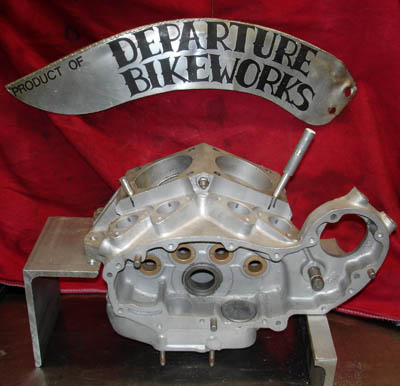
I’ll try to innumerate several of the 45 cubic-inch, side valve
performance suggestions. Originally we discussed dual front
cylinders for dual carbs and better air flow. There’s a problem
with that recipe. First we found that K-Model top ends flow even
better than dual carbs. Plus trying to find and possibly breaking
up two sets of rare WLDR top ends wasn’t a friendly formula and
a tough menu to follow.
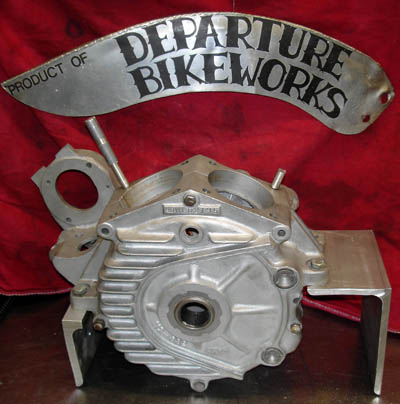
That’s not all. Jim Lienweber would be forced to grind some
very exotic cams for the dual-carb job, whereas a clean set of
WLDR cams fit the golden formula for 45 speed.
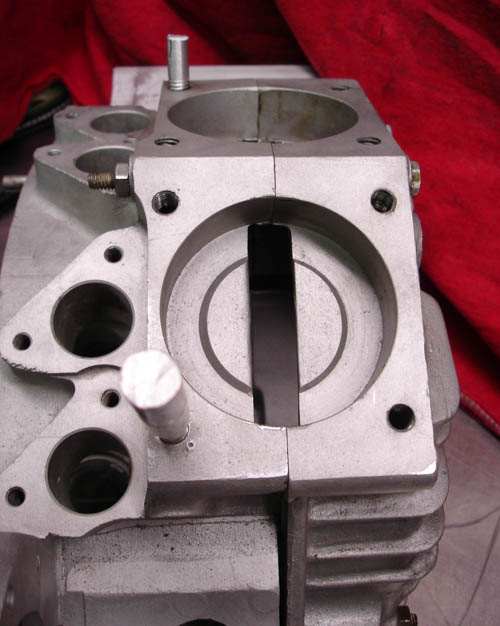
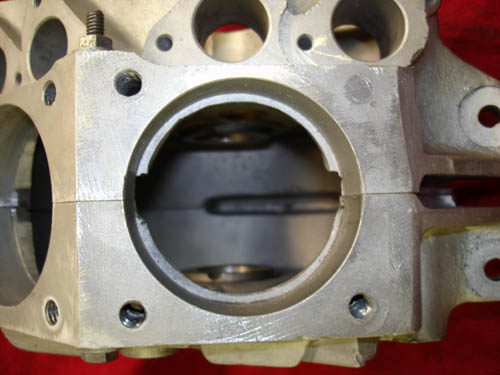
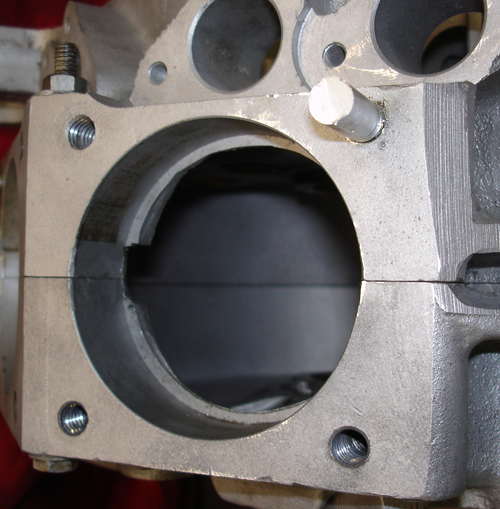
There’s a baffle in one of the cylinders to create just the
right mixture of oil to enter the cylinder under the piston of a
stock 45. In the above case, part of our speed mixture, called for
baffle removal to allow the piston to scream up and down the
cylinder unhampered. Backing up that modification called for
machining the breather gear in the cam case to create the ideal
vacuum, let the motor breathe and the air evacuate. This also
forced Ross pistons to deliver three piece oil rings over the stock
one piece jobs.
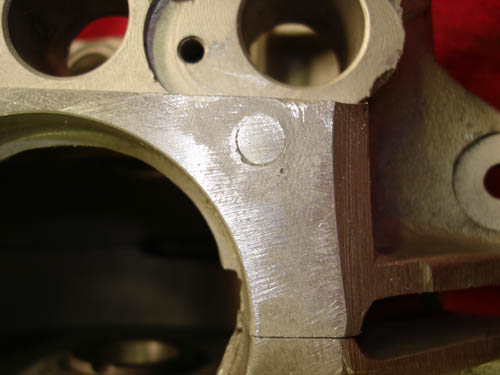
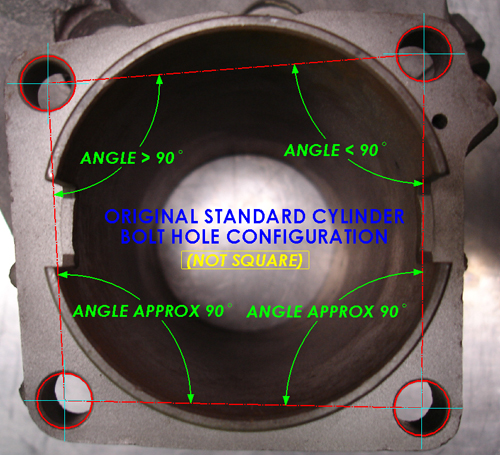
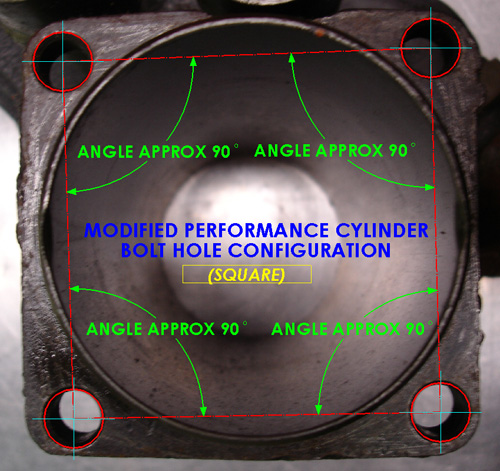
In order to mount the K-Model top end, the precursor to the
Sportster, a stud needed to be moved. Flatheads have four
square
studs, like at the corners of a square box. Sportsters and K-
models come with one stud, slightly out of wack. It forced Lee to
machine aluminum studs, run them into one cylinder mounting,
case
stud hole, slice it off and re-face the surface.
That’s not all. The cylinders needed to be measured from
the crankpin up so that the head lands on the cylinders were
perfectly square and the same between the cylinders for exact
compression.
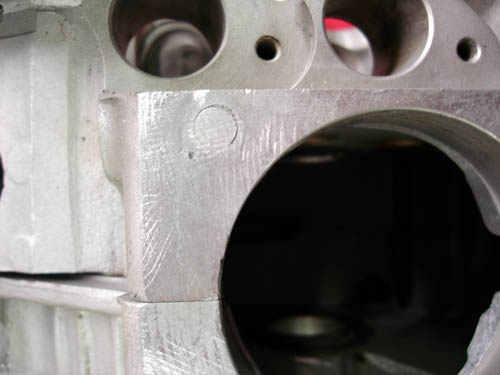
That’s not all. Lee needed to check the face of the heads
and make them absolutely square with the top of the cylinders.
Lee discovered that there was a difference in the thickness
of the heads from the valve side to the combustion side. He
made a fixture to hold the heads perfectly square (upside down)
so he could
machine the correction into the mating surface between the
aluminum heads and the iron cylinder head gasket surface. It
took him a while to discover all headbolt surfaces are not
created equal. He was forced to study the distances from the
head gasket area to the headbolt washer landing to determine
how to create the ideal fixture. He burned through another day
in the shop trying to
create the Worlds Fastest 45 Flathead.
That’s not all. Skeeter Todd dropped into Departure Bike
Works to discuss all that’s performance in the kingdom of
Harleys and the conversation shifted to the Bonne Belle. “What
transmission are you going to use,” Skeeter said. Skeeter is like
a monk from the flathead piston tribe in the Catskill Mountains.
When he asks a question—he knows the answer.
“The stock 1940 three-speed with a tall rear sprocket,”
Lee
timidly muttered, knowing he was about to have his ass handed
to
him.
"With a stock 3-speed you will fall off the cam in third
gear, and struggle through miles trying to retrieve the needed
rpms to reached the peak power curve," Skeeter pointed out
graciously. The stock
transmission
was out. Lee has a connection for wrecked bikes through
insurance companies and volunteered to cut a 5-speed
transmission off a late-model Sportster and ship it to the other
coast. “One problem,” he said. We need to seal up the case and
develop a means to fill it with oil.”
Seems S&S makes a trap door with an oil fill hole and
sealed bearings. Then it’s up to me to form the welded
transmission case and mount it in the exact location from the
engine drive sprocket as a Sportster, so we can run a Sportster
designed belt system. We will also run the late model Sportster
clutch.
Another beneficial project.
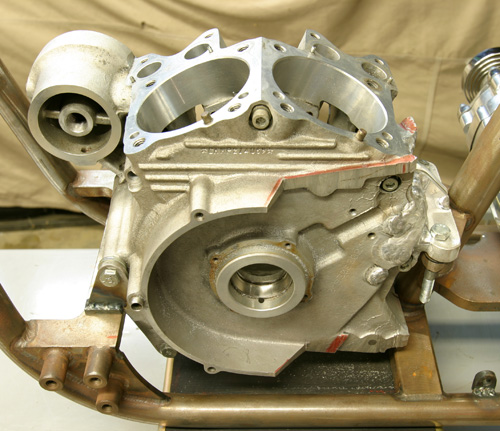
I immediately called Greg Friend, the former Street
Chopper
editor, who now is the West Coast Editor of Barnett’s Magazine.
He cut a Sportster transmission free from the case to build a
split Sportster custom. “Ah, I sold the transmission at a swap
meet,” Greg said. “I’m using a Baker big twin transmission.”
I couldn’t believe my ears. See the image above.

Pin-Up Progress Report

Recently at a secret Bikernet Headquarters Meeting we dug
out Vargas books and 1940s pin-up calendars from the Bob T.
collection. We discussed every detail of a woman’s body, all in
an
effort to perfect the Assalt Weapan nose art. Like so many of our
projects, it had specific guidelines. We needed to determine
where the girl would pose, on what fender, tank, etc.

We decided on the front fender, so it called for a specific
position. “What about her straddling a gattling gun?” Wrench
suggested.
The more we looked, the more that position worked. Chris
went to work.
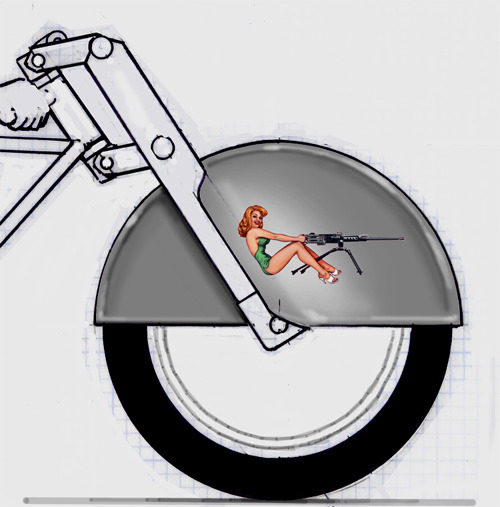
The girl was too long and small on the fender in this case
and we decided to machine the barrel down. At the same time
we discussed attitude, the wind, her hair and action.

With each rendition she transcended the last version and
we weren't done yet. Watch as she outwits the artist. Next
chapter
we'll bring the Bonne Belle transmission home and parts will
arrive from Ted Tine to finish the 45 headwork.

The Paughco Frame will make muster at the Headquarters
soon,
and we’ll scramble to test the wheels and front end geometry
against Paughco frame realities. Then we’ll match the womanly
curves of Valerie Thompson to the style and grace of our steel
components and get to work on the sheet metal. Hang on.


 Bikernet
 Bikernet Baggers
 Women Riders Now